
When the Skies Turn Gray: How Wildfire Smoke Affects Asthma and How to Protect Your Lungs
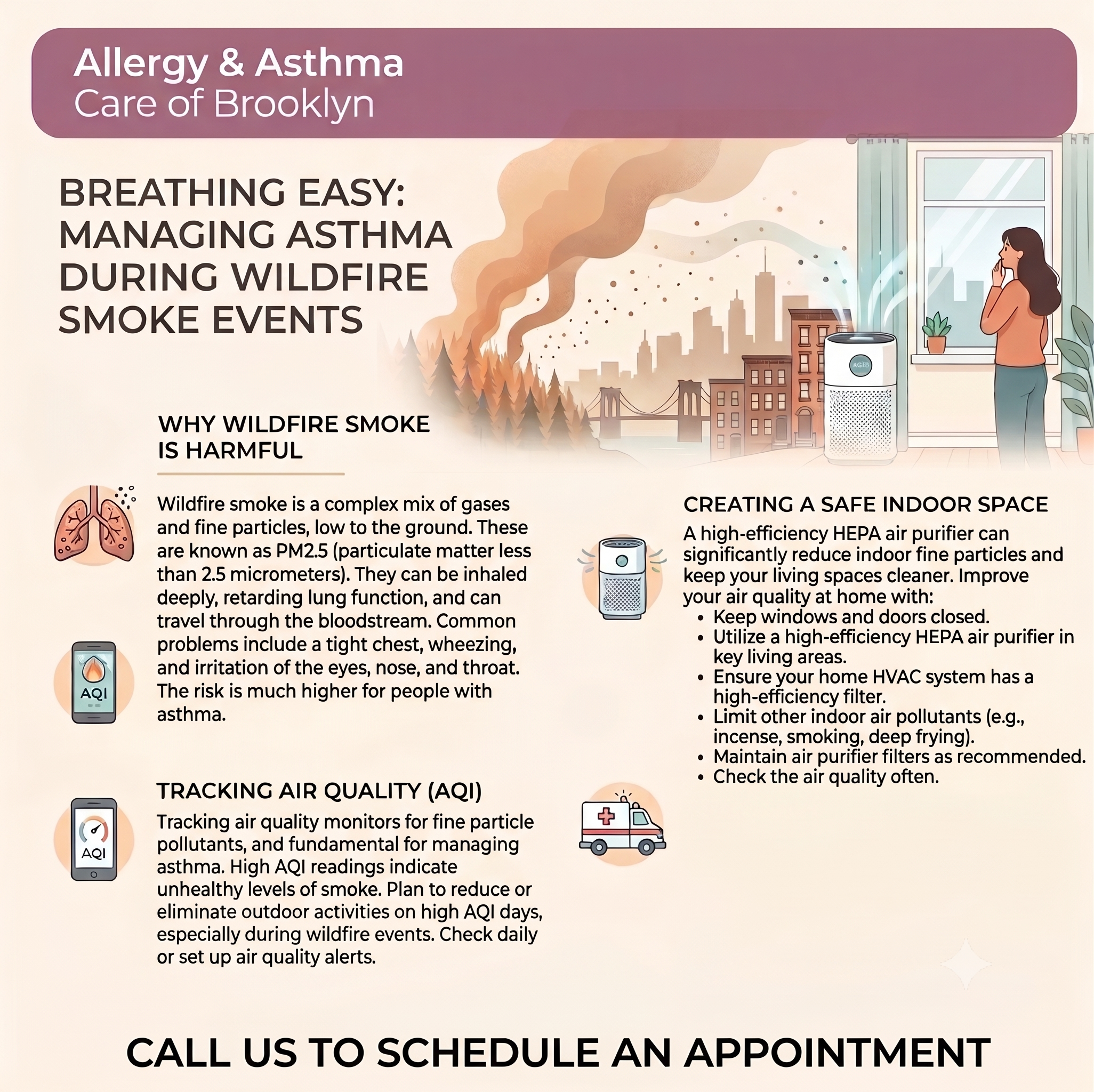
In recent years, Brooklynites have become all too familiar with hazy skies and orange-tinted horizons. As wildfires become more frequent and severe across North America, the resulting smoke can travel thousands of miles, heavily impacting the air quality right here in Brooklyn.
For the average person, wildfire smoke is a nuisance that causes scratchy throats and watery eyes. But for individuals living with asthma, it poses a severe, immediate health risk.
At Allergy & Asthma Care of Brooklyn, we want to ensure our community stays safe and breathes easy when the air quality dips. Here is what you need to know about wildfire smoke and how to protect your lungs.
Why Wildfire Smoke is a Major Asthma Trigger
Wildfire smoke is not just ash and soot; it is a complex, toxic mix of gases and microscopic particles produced when wood, vegetation, and buildings burn.
The primary culprit behind asthma flare-ups is PM2.5 (fine particulate matter). These particles are less than 2.5 micrometers in diameter—about 30 times smaller than the width of a single human hair. Because they are so small, they bypass your body’s natural defense mechanisms in the nose and throat, traveling deep into your lungs and entering your bloodstream.
For an asthmatic, inhaling PM2.5 triggers:
Immediate airway inflammation: Leading to sudden chest tightness, coughing, and wheezing.
Increased airway hyper-responsiveness: Making your lungs much more sensitive to other everyday triggers like pollen, dust, or exercise.
Reduced lung function: Making it significantly harder to catch your breath, even while resting.
5 Steps to Protect Your Lungs on High-Smoke Days
When a wildfire smoke advisory is issued, taking proactive steps can mean the difference between staying comfortable at home and needing emergency medical care.
1. Track the Air Quality Index (AQI)
Before heading out for a morning jog or sending your children to the park, check the AQI on a trusted site like AirNow.gov or your phone’s weather app.
AQI 0–50 (Green): Good air quality.
AQI 51–100 (Yellow): Moderate. Sensitive individuals should consider reducing heavy outdoor exertion.
AQI 101–150 (Orange): Unhealthy for sensitive groups. Asthmatics should strictly limit prolonged outdoor time.
AQI 151+ (Red and beyond): Unhealthy for everyone. Stay indoors.
2. Create a "Clean Air Room" at Home
When outdoor air quality is poor, keep your windows and doors tightly shut. To keep your indoor air as clean as possible:
Set your central air conditioning or HVAC system to recirculate mode so it doesn't pull smoky air from the outside.
Run a portable air purifier equipped with a true HEPA filter in the room where you spend the most time.
Avoid activities that lower indoor air quality, such as frying foods, lighting candles, burning incense, or vacuuming.
3. Wear a Properly Fitted N95 Respirator
If you must go outside during a smoke event, standard paper dust masks, surgical masks, and bandanas will not protect your lungs from PM2.5. Only a NIOSH-approved N95 or P100 respirator can filter out these microscopic particles. Ensure the mask fits snugly against your face with no gaps.
4. Rely on Your Asthma Action Plan
Make sure your Asthma Action Plan is up to date. Keep your quick-relief (rescue) inhaler with you at all times. If you notice your symptoms starting to flare up due to the smoke, follow the medication adjustments previously outlined by your doctor.
5. Stay Hydrated
Drinking plenty of water helps keep your airways and mucous membranes moist, which allows your body to flush out inhaled particles more effectively.
When to Seek Immediate Medical Attention
Even with the best precautions, a severe drop in air quality can trigger an emergency. Do not wait to see if your symptoms pass. Seek emergency medical care or call 911 if you or a loved one experience:
Severe shortness of breath or struggling to breathe.
Constant chest pain or a feeling of intense pressure.
An asthma attack that does not improve after using a rescue inhaler.
Blue or gray lips and fingernails.
Difficulty speaking in full sentences.
We Are Here to Help
You don't have to navigate changing environmental triggers alone. If you find that your asthma symptoms are becoming harder to control during high-smoke days, or if you need to establish a personalized Asthma Action Plan, the team at Allergy & Asthma Care of Brooklyn is here to support you.
Contact us today to schedule a consultation and make sure your lungs are prepared for whatever the changing seasons bring.